

Packaging sits at the center of the plastics challenge. In Europe, around 40% of all plastics are used for packaging, much of it for single use. (1) At the same time, regulation is tightening fast. The upcoming EU Packaging and Packaging Waste Regulation (PPWR) will require packaging to be recyclable and to include increasing levels of recycled content.
“For us, this is no longer a future discussion,” says Michaela Hrachalova, End to End Packaging Lead at Ontex. “It’s a current business reality. Retailers and brand owners are under increasing pressure to show progress now.”
Why retailers (should) care
For retailers, packaging is becoming a compliance, cost and reputation challenge at the same time:
- Compliance risk: Packaging that does not meet future recyclability, and recycled content requirements may require redesign or adaptation to remain compliant with evolving EU legislation.
- Customer expectations: Consumers increasingly expect visible reductions in virgin plastic use and more circular solutions
- Cost pressure: Delaying the transition increases the risk of last-minute redesigns and supply disruptions
Retailers are asking very concrete questions: can this packaging meet future EU requirements; can it reduce plastic; and can it do so without increasing cost or complexity?
Where mPCR makes a real difference
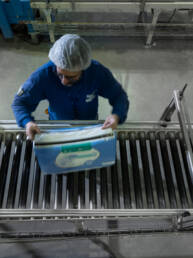
Mechanical post-consumer recycled (mPCR) material is currently one of the most practical ways to deliver immediate progress. It is available today, scalable, and can be integrated into existing packaging systems, where technically feasible.
At the end of 2025, 40% of Ontex’s primary plastic packaging contained recycled content, combining PIR (post-industrial recycled), cPCR (chemically recycled post-consumer) and mPCR content.
In practice, this means:
- integrating recycled polyethylene into flexible packaging films
- maintaining sealing performance, consistent print quality and pack integrity
- running on standard high-speed production lines
- keeping solutions cost‑effective; critical in everyday hygiene products
What it really takes to make it work
Introducing mPCR is not a plug-and-play exercise. In hygiene products, maintaining product protection, safety and barrier performance remains the first priority. While runnability is largely unaffected and sealing performance and pack integrity can be maintained, ensuring consistent print quality across different mPCR production runs remains one of the most visible challenges.
“Ensuring consistent print quality with mPCR requires tight control of material variability and close collaboration with suppliers. At Ontex, we align printing specifications with each supplier to deliver stable results and meet customer expectations,” says Michaela.
This aligns with the broader view in the hygiene sector. Industry associations such as EDANA emphasize that advancing circular solutions must not compromise on safety, while maintaining high standards of product protection and quality across hygiene products. (2)
“The key question is not how much recycled content you add,” says Michaela. “It’s whether the packaging still performs exactly as expected ; on the shelf and on the line.”
How Ontex supports retailers
Ontex focuses on turning recycled content into packaging solutions that work reliably at scale. For retailers and brand partners, this means:
- Future-ready packaging: Solutions aligned with upcoming EU requirements
- Proven performance: Packaging validated to meet required performance and quality standards
- Controlled safety and compliance: Full traceability, supplier certification and validation
Solutions are designed to support roll-out across multiple markets while ensuring compliance.
No compromise on safety
In hygiene products, packaging protects a product’s integrity. Recycled content must meet the same high standards as virgin materials.
This includes:
- chemical risk assessments
- supplier traceability and certification
- migration testing where relevant
A shift already underway
Across Europe, regulation and resource pressure are accelerating the shift toward recycled content, with plastic packaging recycling rates still below 50%, highlighting the need to increase circular material use.
Our focus remains clear:
- Deliver packaging solutions that are circular by design
- Maintain the highest standards of safety and compliance
- Provide cost-effective options that work in real life

That’s how we turn sustainability into something tangible for our customers and consumers; and how we stay true to our purpose: Here for you. Here for the better.
(1) Packaging waste – Environment – European Commission
(2) Source: EDANA Sustainability Vision; EDANA Absorbent Hygiene Products (AHP) Dossier