
Product safety
As a manufacturer of hygiene products, we focus on quality and product safety—because people rely on our products every day. We take a structured, science-based approach across the entire product life cycle: from carefully selecting and assessing raw materials and ingredients, through manufacturing and finished product testing, to ongoing monitoring once products are in use.
We are here for you by continuously strengthening how we assess safety and environmental impact, increasing transparency on what goes into our products, and making it easier to access clear information and support. This end‑to‑end approach helps ensure our products are safe, and can be trusted throughout their entire life cycle.

Active participation
We stay up to date with changing regulations and safety standards by actively engaging in industry associations—so we can act early and meet the right requirements.
Material validation – ensuring safety from the start
When selecting hygiene products, trust in safety, reliability and compliance are essential. That’s why safety starts at the source. Every material used in our products is carefully selected and assessed to ensure consistent performance and safety in real-life use.
This rigorous, science-based validation approach ensures materials meet strict safety and compliance requirements from the start, while supporting traceability and enabling consistent application across different regulatory and operational contexts, including audits and compliance processes.
Our approach is structured, transparent and based on four key pillars:
Regulatory compliance
All raw materials must meet strict legal requirements and recognized industry standards. We also align with additional recommendations, codes of practice and voluntary commitments. Our suppliers are required to confirm compliance, giving you assurance that products meet applicable regulatory expectations.
Trace chemical analysis
All materials are tested to detect and quantify impurities, including those that may originate from raw materials or manufacturing processes.
Particular attention is given to (non-exhaustive): dioxins, furans, PCBs, phthalates, pesticides & herbicides, nonylphenol, bisphenols, cosmetic allergens, polyaromatic hydrocarbons, formaldehydes, heavy metals.
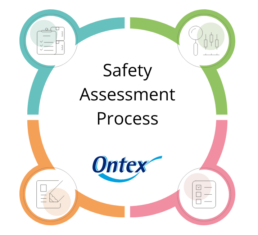
Biological safety
Materials are tested to ensure they are safe for prolonged and direct skin contact. This includes assessing biocompatibility—the ability of a material to perform its function without causing irritation or adverse effects, locally or systemically—supporting safe use across different care environments.
Toxicological ingredient assessment
We require full transparency from our suppliers on material composition. Each ingredient, including potential impurities, is assessed based on its toxicological profile and intended use in the finished product. This enables a thorough, exposure-based risk assessment.
If a risk cannot be adequately mitigated, the material is not approved.
What’s inside our products – designed for safety and comfort
Hygiene products require clarity on their composition and how they perform in practice. Our products are designed using carefully selected materials, each with a specific function to support safety, comfort and reliable protection in everyday use.
An adult or baby diaper, for example, consists of several layers. Each layer contributes to protecting the user and maintaining skin health.
1: Top sheet (in contact with the skin)
A soft, skin-friendly layer that allows liquid to pass through quickly while helping keep the skin dry. It is made from carefully selected natural (cotton or viscose) or synthetic (polypropylene/polyethylene) nonwovens materials to ensure comfort during prolonged use.
2: Acquisition and distribution layer
This layer quickly spreads liquid evenly away from the skin to the absorbent core, helping prevent leakage and maintaining dryness across the product. It is generally made from synthetic non-woven polyester.
3 & 4: Absorbent core
The core locks in liquid and helps keep moisture away from the skin. It combines materials such as cellulose and superabsorbent polymers to ensure high absorption capacity and reliability. Frequently, this core is contained in a core wrap (3).
5: Back sheet (outer layer)
A waterproof film-based protective outer layer that prevents leakage while remaining breathable, supporting skin integrity and user comfort. It is made generally from synthetic polyethylene and polypropylene. Calcium Carbonate can also be used to improve breathability.
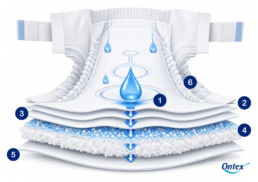
6: Anti-leakage barrier
Synthetic elastic covered by soft non-woven (polyethylene, polypropylene) to prevent leakage from the diaper and optimize fit.
All layers are sealed or glued together thanks to carefully selected adhesives composed of synthetic resin and thermoplastic polymers.
Finished product safety – tested and monitored end to end
Hygiene products need to be safe, reliable, and compliant throughout their use. This is why we perform thorough testing before release and continuously monitor once they are on the market.
Testing before release
Every finished product is assessed to ensure safe, consistent performance:
- Trace chemical analysis: We verify that substances from materials or manufacturing remain within safe limits. We strictly follow the EDANA stewardship program Codex. To know more: Expanding the EDANA Stewardship Programme CODEX™
- Toxicological risk assessment: We assess toxicological chemical risk by qualifying our product under realistic conditions of use and define clear instructions or labelling where needed.
- Biocompatibility testing: Products are tested for safe skin or mucosal contact, following recognized standards (e.g. ISO 10993 series).
Consistent quality, everywhere
Our quality management system ensures:
- Control from production to release
- Safety and compliance in decision-making
- Alignment with recognized standards
Certifications such as ISO 9001 and ISO 13485, alongside BRC and IFS HPC at selected sites, support this approach.
Continuous monitoring after launch
We actively track product performance in real-life use:
- Post-market surveillance: Systematic review of feedback, complaints and reported incidents
- Corrective actions: Expert analysis and actions to address root causes and prevent recurrence
Actively shaping industry standards
We do not only follow evolving regulations; we actively contribute to shaping them. Through our long-standing participation in leading industry associations like EDANA and BAHP, we help develop guidance, standards and best practices that define product safety in our sector.
Our teams are directly involved in working groups, technical committees and expert discussions, where we share data, contribute scientific expertise, and help build alignment across the industry. This ensures that emerging standards are practical, science-based and relevant for real-life use.
Beyond monitoring regulatory changes, this active engagement allows us to anticipate new requirements early, adapt our processes in a timely way, and support consistent safety expectations across markets.
Our involvement includes organizations such as EDANA and regional industry bodies, where we collaborate with peers, regulators and experts on topics ranging from product safety and testing methods to material requirements and responsible product use.
Our view on product safety
Click to access our position statements and other relevant documents related to product safety.